



Find out the accessibility level of your
municipality on a scale of 0–100
The Accessibility Index evaluates the current state of accessibility across different facilities in your municipality and provides a clear numerical score on a scale of 0–100. The Accessibility Index helps identify areas for improvement, prioritize actions based on resources and goals and communicate accessibility reliably and credibly to different stakeholders, faster and more cost-effectively than traditional accessibility audits.
What is the Accessibility Index?
The Accessibility Index indicates the level of accessibility of a building or a space on a scale of 0–100 – faster, more agile, and more cost-effective than traditional accessibility audits.
With the Accessibility Index, you get:
- A prioritized list of the most important accessibility actions in as little as a few days
- Clear and comparable metrics on the accessibility of your spaces – no unnecessary guesswork
- Timely information on required improvements without unnecessary work or wasted resources
- A comprehensive view of the current state of accessibility across all key areas: mobility, visual accessibility and auditory accessibility
Try it for free
Our satisfied public sector clients




Accessibility issues are often discovered too late and they come at a high cost
Accessibility shortcomings in municipal facilities do not stay hidden. They surface in customer feedback, the media and ultimately in renovation budgets. The Accessibility Index reveals the true state of facilities and helps prioritize actions before issues escalate out of control.
Three things that cost municipalities more than they should:
Corrective fixes. Modifications are made to properties every year, and a large share of them could have been done correctly the first time. Accessibility shortcomings that are only identified after renovation can result in additional costs of tens of thousands of euros. Without up-to-date information on the condition of facilities, prioritization becomes guesswork and budgets are allocated to the wrong targets.
Resident feedback and reputation. When a resident submits feedback about stairs at a library or barriers at a health center, decision-makers rarely have factual information about the real situation of the premises. Dysfunctional spaces do not go unnoticed: they generate complaints, social media reactions and negative publicity. A situational view based on measured data turns individual complaints into manageable development work.
Equality plan. An equality plan is mandatory for all municipalities, and it should be based on a realistic assessment of the current situation. In most municipalities, the understanding of physical accessibility relies on outdated, heavy accessibility audits or individual reports without a unified overall picture. Without measurable and comparable data, the true state of accessibility easily remains unclear.
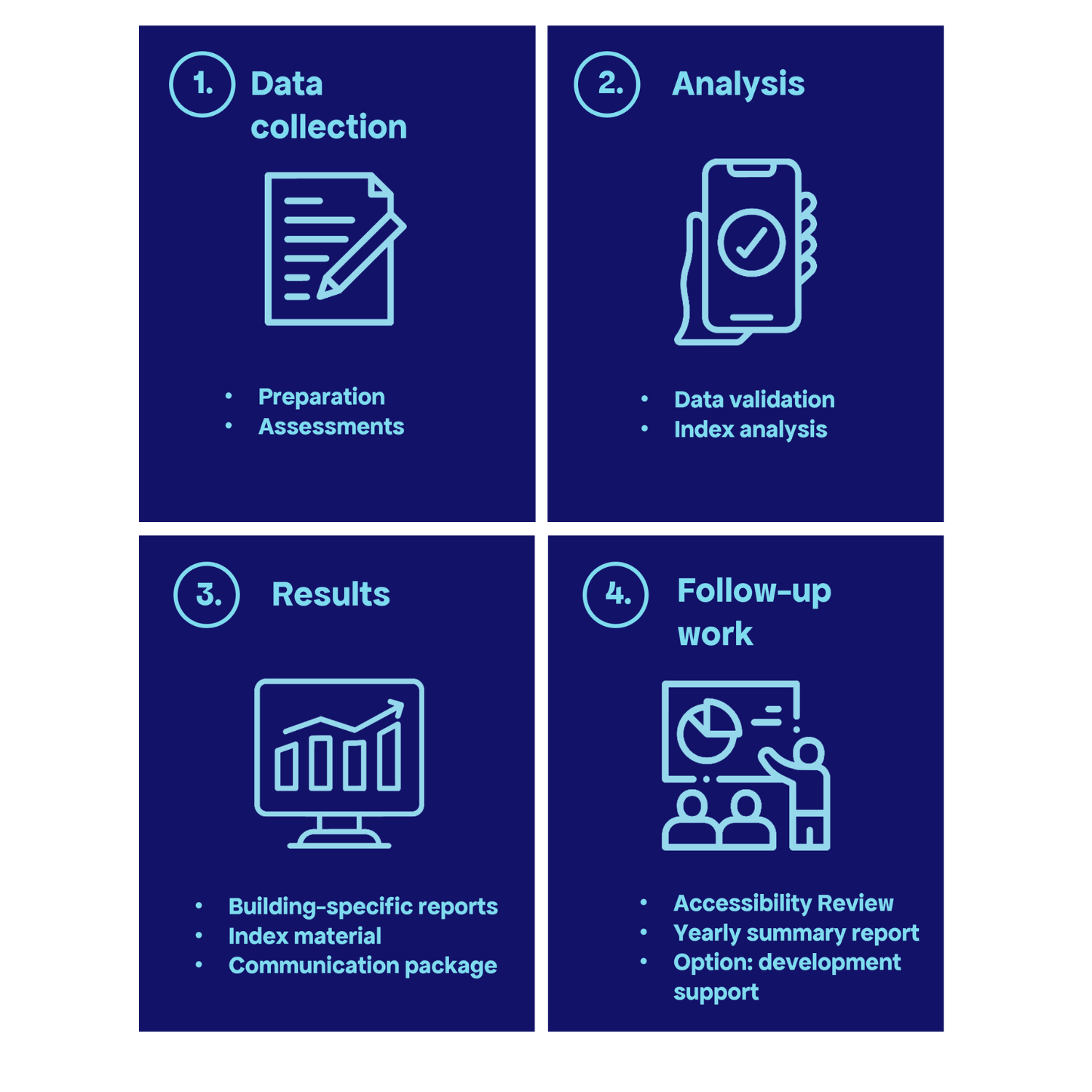
Accessibility indexing is more agile than you might think
Traditional accessibility audits are often lengthy projects: a consultant visits the site, the report is completed weeks later and the results are already outdated. The Accessibility Index works differently. Data collection is carried out independently by your own staff, the analysis is automated and the results are available in days, not months.
Try it for free
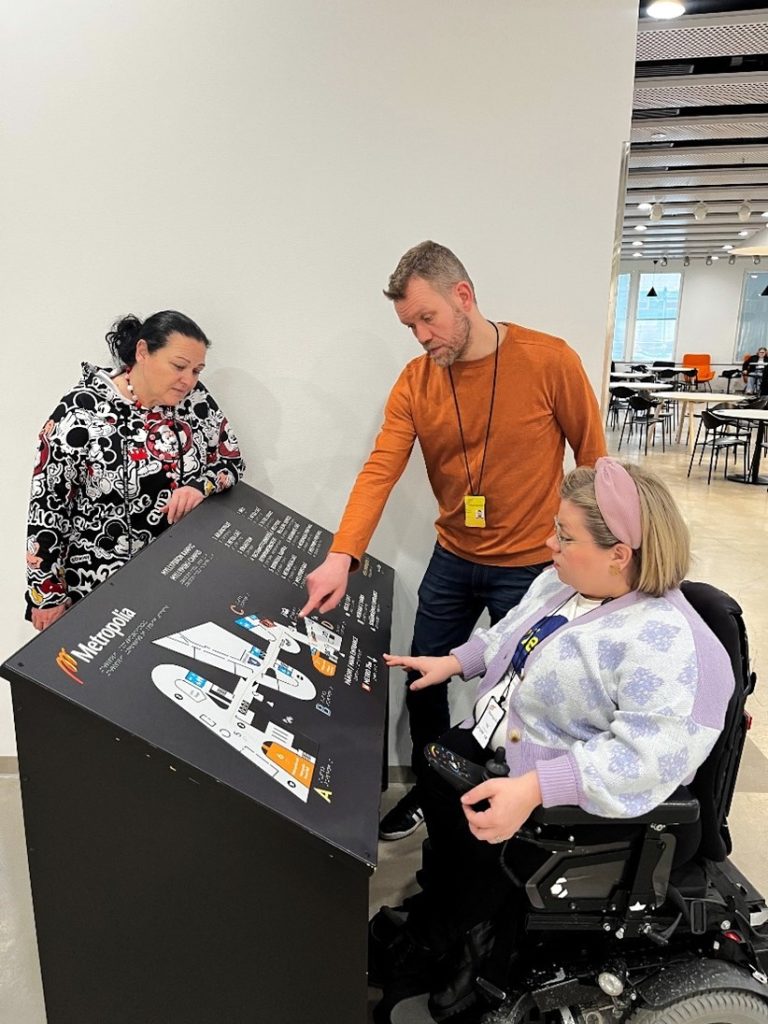


“Considering accessibility from the very beginning of the design phase is significantly more cost-effective than making corrections afterward.”
Juha Välitalo, Head of Construction, City of Rovaniemi
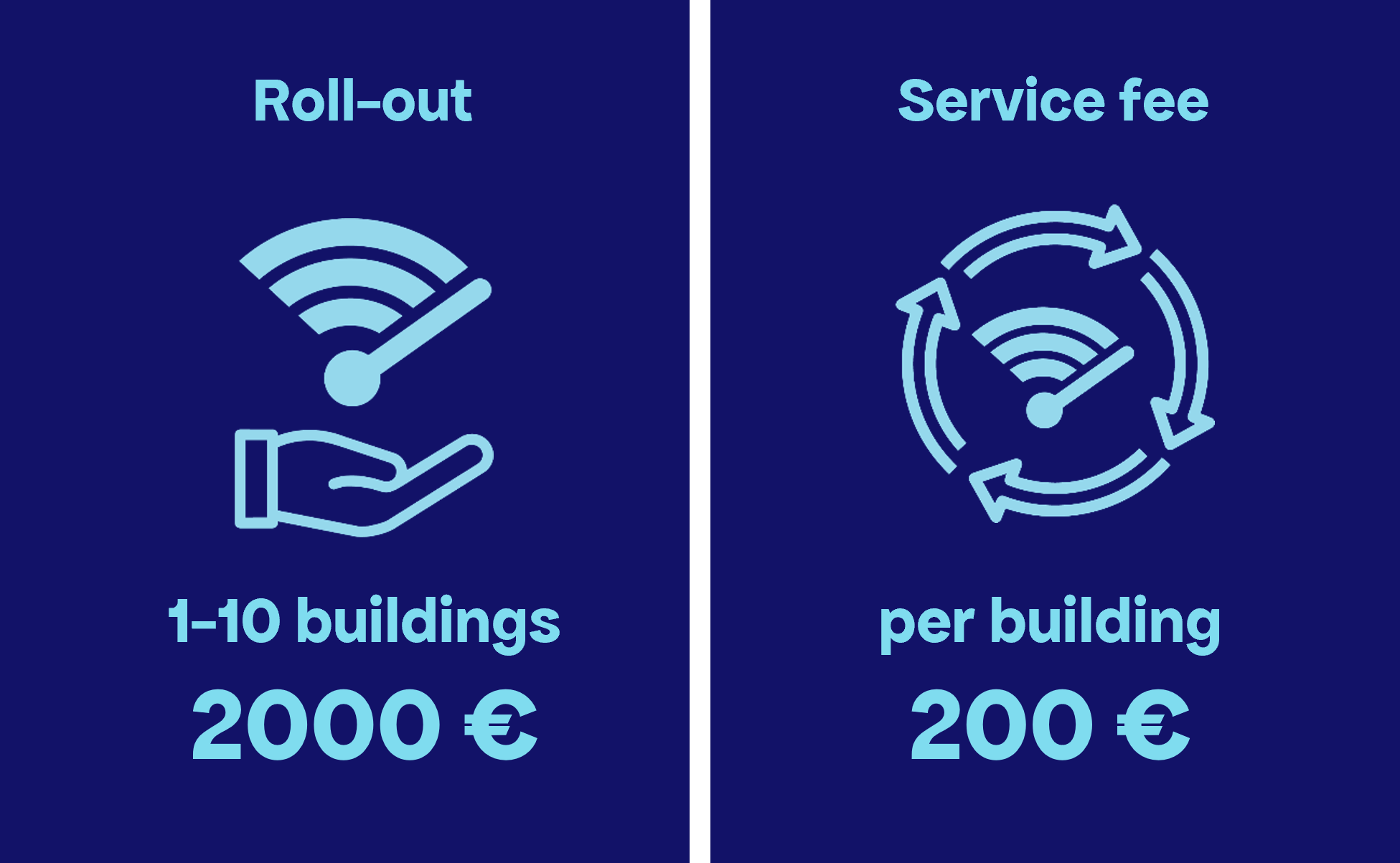
Clear pricing, no surprises
Service setup from €2,000 (up to 10 sites) + €200/site/year. The service includes:
- An annually updated report on the current state of accessibility
- Timely insights into accessibility and how to improve it (Accessibility Review)
- The right to use index materials in your own communications
Data collection is carried out by the municipality’s own staff using an easy-to-use tool developed by Riesa.
Try it for free
Frequently asked questions
Does the Accessibility Index only cover legislation?
No, it does not. The Accessibility Index is not limited to legal requirements, instead it approaches accessibility more broadly from a user experience perspective. In addition to statutory requirements, the Accessibility Index considers practical usability and smoothness. In other words, how well spaces serve different users.
Can I discontinue the Accessibility Index if I want to, and how?
You can cancel the Accessibility Index at any time. The service will end at the conclusion of the notice period. Please note that once the service ends, you will no longer be able to use materials related to the Accessibility Index, such as the index score logo.
How is data collection carried out in practice?
Data collection can be carried out by anyone, as the application developed by Riesa guides the user clearly step by step. In most cases, data collection is conducted by the organisation’s own staff, who are most familiar with the premises.
Accessibility is already part of our sustainability programme. Does the Index still provide value for us?
Yes, it does. Even if accessibility is already included in your sustainability programme, the Accessibility Index adds clarity and measurability. It provides a clear overall view of the current situation, helps identify areas for development and enables you to prioritise actions and track progress. In addition, the Index provides a solid foundation for sustainability communication and reporting.
We are not able to implement all actions. Is it still worth starting the process?
Absolutely. Accessibility development does not need to be completed all at once, it can be carried out step by step. There are often also measures that can be implemented quite easily, without major investments. The Accessibility Index helps identify these and prioritise development so that efforts are directed at the most impactful actions. The key is to get started and proceed systematically.
We have already done a lot of development work. What added value does the Accessibility Index bring?
The Accessibility Index brings together the work that’s already been done and makes it visible. It provides a clear overall view of the current situation and ensures that development has been consistent and covers all key areas. The Accessibility Index also helps to identify potential blind spots, measure progress and support communication by providing clear, comparable data for example for reporting purposes.
We find it challenging to gain support for accessibility development. Can the Accessibility Index help with this?
Yes, it can. The Accessibility Index provides concrete and well-founded information that makes it easier to gain support within your organisation. It makes the current state and development needs visible and helps to demonstrate which actions should be prioritised and why. This shifts the discussion from general opinions to clear and justified development proposals.